High-Intensity Focused Ultrasound (HIFU) revolutionized non-surgical SMAS lifting, yet single-modality dot-matrix ultrasound often faces two clinical bottlenecks: sharp periosteal stinging along thin jawline bone and slower superficial dermal collagen tightening. A MMFU RF dual-modality lifting machine resolves both limitations by firing Micro-Macro Focused Ultrasound synchronously with monopolar or multipolar radiofrequency—cutting patient discomfort while doubling multi-plane neocollagenesis across the SMAS, reticular dermis, and delicate 2.0mm periorbital corridor.
Clinical Engineering Callout: Why Synchronous MMFU + RF Outperforms Sequential Pass Protocols
When radiofrequency pre-heats collagenous septa and lowers acoustic impedance resistance immediately prior to—or synchronously with—an ultrasound focal burst, Thermal Coagulation Points (TCPs) reach the 65°C–75°C threshold at roughly 25%–30% lower peak acoustic wattage. Patients experience smooth deep warmth instead of sharp bone-echo zaps, while Type I and Type III collagen synthesis accelerates across both the 1.5–3.0 mm dermis and 4.5 mm SMAS fibromuscular layer.
1. Biophysical Synergy of Synchronous MMFU + Radiofrequency Architecture
Conventional HIFU transducers rely solely on high-frequency acoustic pressure waves (4 MHz to 7 MHz) converging at a focal point beneath an acoustically coupled gel pad. While acoustic focusing excels at creating discrete 1 mm³ thermal coagulation points at 4.5 mm inside the Superficial Musculoaponeurotic System (SMAS), it leaves the inter-dot connective tissue and superficial papillary dermis largely untouched unless multiple shallow cartridges are stacked sequentially.
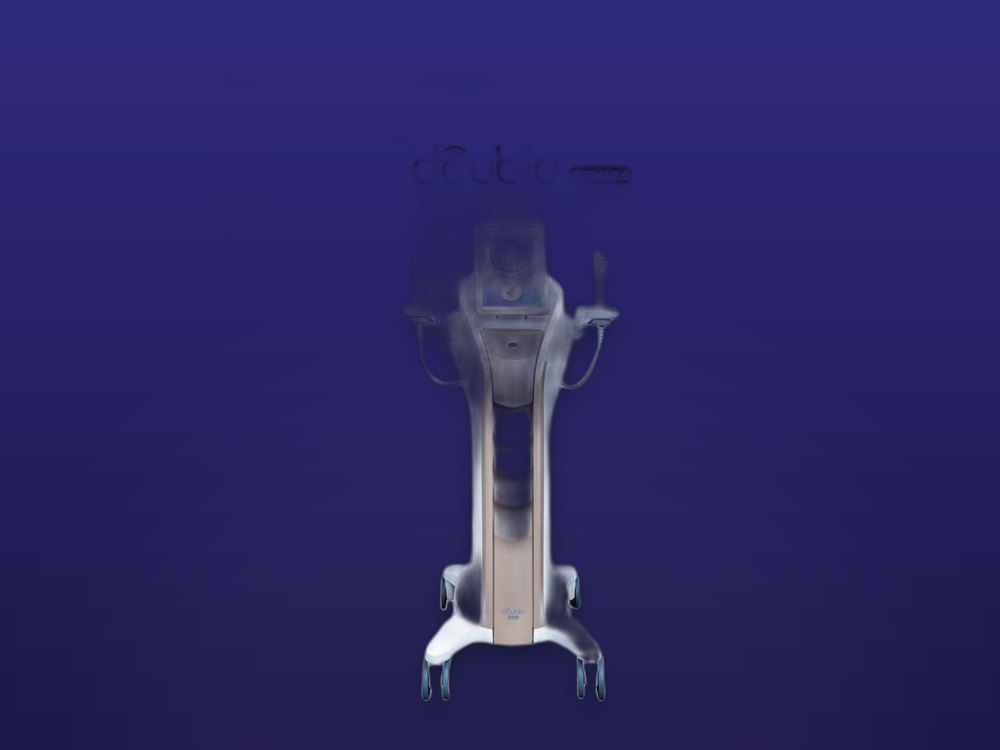
By contrast, a MMFU RF dual-modality lifting machine integrates concentric or ring-shaped radiofrequency electrodes directly onto the distal face of the ultrasound transducer cartridge—exemplified by the NEW DOUBLO MMFU + RF Dual-Modality System. As the handpiece glides across coupling gel, radiofrequency current pre-warms the dermis (40°C–45°C) while focused MMFU fires pinpoint 65°C–75°C thermal coagulation zones precisely into the target fascia.
- Dual-Plane Acoustic + Capacitive Heating: Radiofrequency delivers uniform volumetric dermal tightening while MMFU anchors deep vertical structural vector lift at the SMAS.
- Reduced Peak Wattage Pain: Pre-warming collagen fibers reduces the temperature delta required to reach 65°C coagulation, lowering VAS pain scores from 6–7/10 down to 2–3/10 without oral analgesics.
- Inter-Dot Connective Bridging: RF thermal diffusion links adjacent ultrasound TCPs into a cohesive fibro-septal remodeling web for sharper jawline and nasolabial contouring.
2. The 2.0mm MF2 Slim Periorbital Transducer Protocol
Standard 1.5 mm and 3.0 mm HIFU cartridges use wide rectangular footprint housings designed for broad cheek and submental planes. Attempting to maneuver a wide housing over the curved supraorbital ridge, lateral canthus, or infraorbital tear trough frequently results in uneven gel coupling, surface acoustic burns, or missed anatomical zones.
The dedicated 2.0mm MF2 Slim Transducer (5.5 MHz) overcomes these anatomical constraints with a narrow tapered tip engineered specifically for tight facial contours. Operating at 5.5 MHz, the MF2 cartridge focuses micro-thermal energy cleanly at 2.0 mm within the thin periorbital and perioral reticular dermis—safely superficial to the deep orbital septum yet deep enough to contract lateral canthal crow’s feet, elevate mild upper-eyelid hooding, and soften vertical smoker’s lines.
When treating the periorbital frame, retract the eyebrow skin slightly upward onto the bony supraorbital rim so no ultrasound energy ever fires directly over the open globe. Deliver 80–120 lines per eye in fanning horizontal and vertical vectors at 0.3–0.5 J per dot, maintaining continuous perpendicular contact pressure and ample acoustic gel.
3. Full-Face Dual-Modality Clinical Stacking Matrix (4.5mm, 3.0mm, 2.0mm, 1.5mm)
For comprehensive non-surgical facelifting, clinicians execute a top-down or deep-to-superficial vector sequence combining deep SMAS anchoring with synchronous RF dermal refinement:
- Deep Vector Anchor (4.5 mm SMAS + RF): 200–300 lines across the lower buccal cheek, jawline margin, and submentum at 0.7–1.0 J to tighten fibromuscular slings and lift jowl ptosis.
- Mid-Dermal Matrix (3.0 mm Deep Dermis + RF): 200–250 lines across malar fat pads, nasolabial folds, and marionette vectors at 0.5–0.7 J to shrink fibrous retaining septa.
- Precision Contouring (2.0 mm MF2 Slim + RF): 150–200 lines around the periorbital brow arch, crow’s feet, glabellar lines, and upper-lip vermilion border at 0.3–0.5 J.
- Superficial Pore & Neck Polish (1.5 mm + RF): 100–150 lines across thin forehead skin and horizontal neck creases at 0.2–0.3 J to smooth fine epidermal crepiness.
4. Safety Architecture: Motion Detection, Tilt Sensors & Bone Avoidance
Because synchronous ultrasound and radiofrequency deliver compounded thermal energy, hardware safety interlocks are mandatory to prevent stacked thermal burns. Advanced dual-modality platforms incorporate real-time optical/capacitive contact sensors and gyroscopic tilt detectors: if the clinician pauses too long over a single millimeter or tilts the cartridge away from flush 90° contact, both RF emission and MMFU firing suspend instantaneously.
Clinicians must still map anatomical danger zones with a surgical skin marker prior to firing—strictly avoiding the marginal mandibular nerve branch over the mid-mandibular notch, the supraorbital neurovascular bundle, and the midline thyroid cartilage of the anterior neck.
Clinical Comparison: Synchronous MMFU + RF vs. Conventional Single-Modality HIFU
Evaluate clinical comfort, depth synergy, periorbital precision, and treatment efficiency between dual-modality MMFU+RF and legacy HIFU platforms:
| Engineering & Clinical Metric | Synchronous MMFU + RF Dual-Modality | Conventional Single-Modality HIFU |
|---|---|---|
| Energy Delivery Mechanism | Simultaneous focused ultrasound + RF pre-heating | Pulsed focused ultrasound dots only |
| Periorbital Contour Access | Narrow 2.0 mm MF2 5.5 MHz Slim Transducer | Wide flat housing (limited rim conformity) |
| Target Thermal Synergy | 65°C–75°C TCPs + 42°C volumetric dermal bridge | Isolated 65°C–75°C TCPs with untreated gaps |
| Patient Pain Profile (VAS 0–10) | 2.0 – 3.5 (No oral sedation needed) | 5.5 – 7.5 (Periosteal stinging common) |
| Session Efficiency | 25 – 35 min full face & eye protocol | 45 – 60 min multi-cartridge pass |
| Neocollagenesis Window | Immediate RF tightening + 90–180 day SMAS lift | Delayed 60–120 day acoustic remodeling |
5. Post-Procedure Recovery Timeline & Multimodal Protocol Integration
Because both the focused ultrasound beam and surface RF electrodes keep the stratum corneum 100% intact, patients leave with zero bruising or crusting—showing only mild rosy erythema that fades within 2 hours. Advise patients to avoid ice packs or anti-inflammatory NSAIDs for 72 hours post-treatment so the natural macrophage-to-fibroblast TGF-beta healing cascade proceeds unimpeded. For thin-skinned patients needing extra epidermal barrier resilience, pair a quarterly dual-modality lift with bi-weekly cellular ultrasound hydration.
6. Contraindications, Pacemaker Screening & Patient Expectation Management
- Absolute Contraindications: Implanted cardiac pacemakers, defibrillators, metallic facial plates/screws directly within the RF current pathway, active cystic acne or open herpes lesions, pregnancy, and bleeding disorders.
- Filler Spacing Rule: Wait at least 4–6 weeks after hyaluronic acid dermal fillers or biostimulator injections (PLLA/CaHA) before delivering deep 3.0–4.5 mm MMFU+RF over the exact same anatomical plane to avoid accelerated enzymatic gel degradation.
- Realistic Outcome Framing: Position synchronous MMFU+RF as non-surgical structural preservation and moderate vector lifting peaking at Day 90, ideally repeated every 9–12 months.
7. Transducer Shot-Count Economics, Acoustic Gel Selection & Clinical ROI
From an operational standpoint, combining focused ultrasound and radiofrequency inside a single cartridge markedly improves clinic profit margins and appointment throughput. Standard single-modality HIFU often requires 600–800 shots across multiple cartridges plus a separate 40-minute monopolar RF visit to address both fascia laxity and superficial crepey skin. With synchronous MMFU RF dual-modality lifting machine delivery, clinicians execute 400–550 total lines in one integrated 30-minute pass—cutting consumable cartridge depreciation per patient by 25% while commanding premium combination-therapy pricing.
To preserve piezoelectric acoustic efficiency and RF electrode conductivity across thousands of lines, utilize purely water-soluble, salt-balanced ultrasound transmission gel free of essential oils, lidocaine creams, or silicone thickeners. Residual oil films insulate the concentric RF ring, triggering impedance-fault pauses, while air micro-bubbles inside low-grade gel scatter 5.5 MHz and 7 MHz ultrasound waves into the superficial epidermis. Wipe and reapply a crisp 2 mm gel layer before each anatomical quadrant, and inspect gold-plated RF contact rings weekly for dried gel buildup.
8. Standardized Pre-Treatment Marking & Post-Treatment Photographic Documentation
Reproducible non-surgical lifting requires disciplined preoperative vector mapping with the patient seated upright at 90 degrees before reclining onto the treatment table. Gravitational ptosis shifts malar fat pads and jowl vectors significantly once supine; marking the mandibular border, nasolabial shelf, zygomatic arch, and marginal mandibular nerve safety zone while upright ensures every 4.5 mm and 3.0 mm anchor line pulls along genuine anti-gravity vectors. Capture 0°, 45°, and 90° standardized studio portraits under identical overhead lighting at Baseline, Day 30, and Day 90 to quantify brow elevation, submental sharpness, and lateral canthal smoothing objectively.
Clinical Integration, Product Architecture & Pillar Reference
Deploy dual-modality acoustic and capacitive facial lifting with the NEW DOUBLO MMFU + RF Lifting System, featuring the dedicated 2.0mm MF2 periorbital transducer and real-time contact sensors. For full 7-cartridge depth science and SMAS healing biology, read our comprehensive medical aesthetic HIFU device clinical pillar guide.
Frequently Asked Questions (Clinical & Engineering)
How does a MMFU RF dual-modality lifting machine reduce HIFU pain?
Radiofrequency pre-heats dermal collagen and lowers acoustic impedance immediately as the ultrasound pulse fires, allowing Thermal Coagulation Points to reach 65°C–75°C at lower peak wattage without sharp periosteal shock.
What is special about the 2.0mm MF2 slim transducer?
Its narrow tapered 5.5 MHz cartridge conforms snugly along the orbital rim, crow’s feet, and upper-lip lines—areas too tight for wide 1.5 mm or 3.0 mm housings.
How soon do patients see results after synchronous MMFU + RF?
Immediate collagen fiber shrinkage from the RF component gives subtle day-one firmness, while deep SMAS and dermal neocollagenesis peak progressively between Weeks 8 and 16.