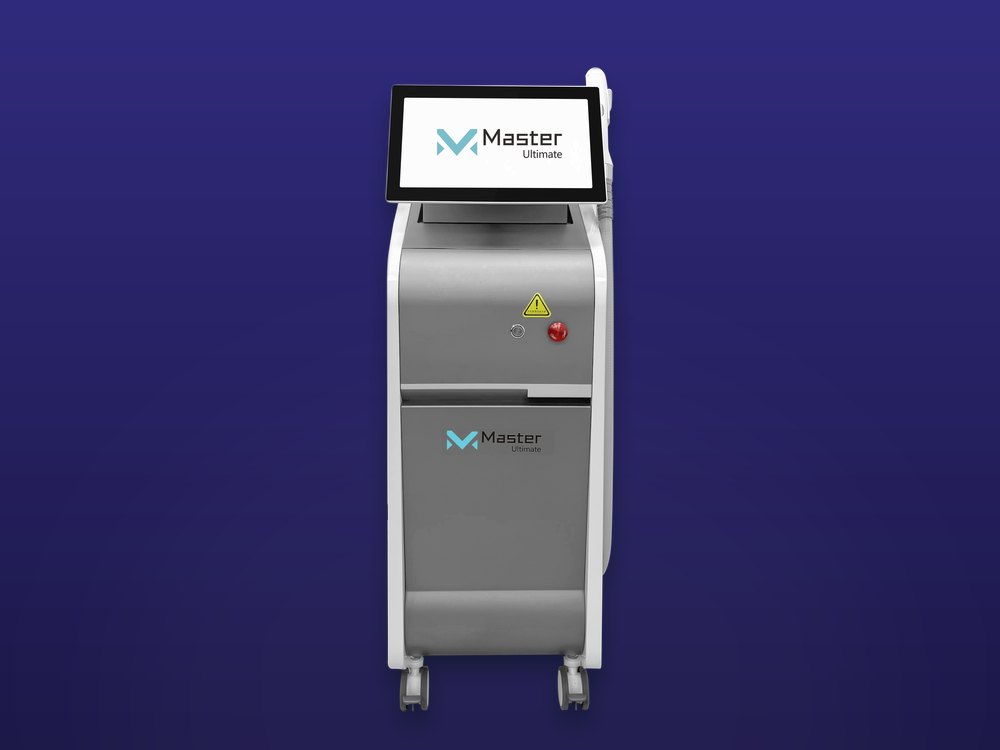
Broadband intense pulsed light remains the cornerstone workhorse for multi-chromophore photoaging, yet legacy free-discharge IPL handpieces suffer from dangerous energy spikes at the leading edge of each pulse followed by an ineffective thermal tail. Modern OPT super photon square-wave IPL and Advanced Optimal Pulse Technology (AOPT) platforms regulate capacitor output into flat-top square pulses across six calibrated cut-off filters—from 420 nm acne sterilization to 695 nm deep vascular and hair photorejuvenation.
Clinical Engineering Callout: Square-Wave OPT/AOPT Capacitor Stability vs. Exponential Decay
In conventional IPL systems, voltage drops exponentially as the flashlamp discharges—spiking well above target melanin thresholds during the first millisecond (causing epidermal blistering) and sagging below vessel coagulation thresholds by the end of the pulse. An OPT super photon square-wave IPL platform maintains constant current throughout every sub-pulse and lets clinicians independently program the fluence and millisecond width of each sub-pulse in AOPT dual/triple-pulse trains for safe, predictable heating across Fitzpatrick I–IV skin.
1. Optical Physics of Square-Wave OPT & Multi-Subpulse AOPT Engineering
Broadband xenon flashlamps emit continuous polychromatic radiation spanning 400 nm to 1,200 nm. Without precise spectral filtering and real-time power-supply regulation, short ultraviolet-blue wavelengths scatter heavily in the upper epidermis while deep infrared wavelengths heat dermal water indiscriminately. Square-wave Optimal Pulse Technology solves both physics challenges through high-capacity capacitor banks paired with sapphire contact cooling (0°C to -5°C) and interchangeable optical dichroic cut-off filters.
Every cut-off filter blocks all photons shorter than its nominal nanometer rating while transmitting longer wavelengths cleanly into the dermis. On Advanced OPT (AOPT) systems, clinicians further tailor pulse geometry: dividing a single 15 J/cm² shot into two or three controlled square sub-pulses separated by 10–30 ms thermal relaxation pauses. Because thin epidermal melanin cools significantly faster (TRT ~1–3 ms) than dilated 0.2–0.5 mm telangiectasias (TRT ~10–30 ms), multi-subpulse AOPT trains protect the epidermis while driving intravascular oxyhemoglobin to 70°C coagulation.
- Flat-Top Fluence Uniformity: Eliminates leading-edge energy overshoot, slashing post-treatment crusting and checkerboard striping on cheeks and décolletage.
- Independent Sub-Pulse Tuning: Allows higher initial fluence to warm large vessels followed by gentler sustaining pulses, or uniform gentle sub-pulses for melasma-prone skin.
- Dual-Band Vascular Filtering (500–600 nm): Concentrates photons directly onto oxyhemoglobin absorption peaks (542 nm and 577 nm) while cutting unnecessary melanin interference above 600 nm.
2. Clinical Cut-Off Filter Selection Matrix (420 nm to 695 nm)
Selecting the optimal dichroic filter on an OPT super photon square-wave IPL workstation requires matching target chromophore depth, melanin competition, and lesion caliber across six standard clinical filters:
| Cut-Off Filter | Primary Chromophore | Target Depth | Primary Clinical Indications | Suggested Pulse Train & Fluence |
|---|---|---|---|---|
| 420 nm | Porphyrins (Coproporphyrin III) | 0.3 – 0.8 mm | Active inflammatory acne, C. acnes photodynamic sterilization | 2–3 sub-pulses, 10–14 J/cm², 3.5 ms width |
| 515 nm | Superficial epidermal melanin | 0.2 – 0.5 mm | Solar lentigines, freckles, ephilides in Fitzpatrick I–II | 1–2 sub-pulses, 11–15 J/cm², 3.0–3.5 ms |
| 560 nm | Melanin + superficial oxyhemoglobin | 0.5 – 1.2 mm | General photorejuvenation, dyschromia, mild diffuse redness | 2 sub-pulses, 13–17 J/cm², 15–20 ms pause |
| 590 nm | Oxyhemoglobin & methemoglobin | 0.8 – 1.8 mm | Telangiectasias, rosacea flushing, post-acne erythema (PIE) | 2–3 sub-pulses, 15–20 J/cm², 20–30 ms pause |
| 640 nm | Deep follicular melanin & water | 1.5 – 3.0 mm | Fitzpatrick III–IV photorejuvenation, fine facial vellus hair | 3 sub-pulses, 16–22 J/cm², 25–35 ms pause |
| 695 nm | Deep hair bulb melanin | 2.5 – 4.0 mm | Coarse body hair reduction, deep vascular leg veins | Long 3-pulse train, 18–26 J/cm², 30–40 ms pause |
3. Multi-Pass AOPT Clinical Protocols: Pigment Stacking vs. Vascular Clearing
Rather than blasting a patient’s entire face with one aggressive short-wavelength filter, expert practitioners execute two-pass zonal layering during each 20-minute photofacial appointment. Begin with a global conditioning pass using the 590 nm or 640 nm filter (2–3 gentle square sub-pulses) to warm diffuse dermal vessels and stimulate mild collagen synthesis without irritating background melasma. Then switch to a localized second pass using the 515 nm or 560 nm filter strictly over discrete solar lentigines or nasal telangiectasias using a smaller spot adapter.
Monitor immediate clinical endpoints carefully rather than chasing maximum machine fluence: for epidermal lentigines, look for subtle darkening and crisp perilesional erythema within 3 minutes; for vascular telangiectasias, observe transient vessel blanching or bluish intravascular darkening (“vessel spasm”) followed by mild clearing. Never stack multiple overlapping high-fluence shots on the same square centimeter, as sapphire contact cooling requires 2–3 seconds to re-chill tissue between pulses.
4. Combining Broadband OPT With Picosecond & Q-Switched Lasers
While broadband OPT excels at treating diffuse sun damage, poikiloderma of Civatte, and superficial rosacea simultaneously across large 15 × 50 mm spot windows, stubborn dermal pigment—such as Hori’s nevus, Nevus of Ota, or deep post-inflammatory hyperpigmentation—requires nanosecond or picosecond photoacoustic fragmentation. Clinics routinely pair quarterly AOPT photorejuvenation sessions with targeted 1064 nm Q-Switched laser toning on the HELIOS III Pigment Laser System (spaced 3–4 weeks apart) to clear both superficial vascular-epidermal mottling and deep dermal melanophages safely.
5. Sapphire Crystal Cooling, Gel Optical Coupling & Safety Interlocks
- Optical Coupling Gel Discipline: Apply a uniform 2–3 mm layer of crystal-clear, bubble-free water-based ultrasound gel across the treatment field. Excessively thin gel invites epidermal blistering along the sapphire crystal border, whereas cloudy tinted gels scatter high-energy 515–590 nm light prematurely.
- Fitzpatrick Phototype Guardrails: Restrict aggressive 515 nm and 560 nm filters to Fitzpatrick I–III patients; for Fitzpatrick IV–V skin types, rely on 590 nm, 640 nm, or 695 nm filters with longer 30–40 ms inter-pulse relaxation delays and pre-cool the crystal to 0°C.
- Ocular & Tattoo Avoidance: Always place opaque metal corneal shields or wavelength-rated dark IPL goggles over patient eyes, and keep a 1 cm safety perimeter around eyebrows, scalp hairlines, bearded jawlines, and cosmetic tattoos to prevent unintended hair loss or paradoxical pigment darkening.
6. Xenon Lamp Longevity, Filter Coating Care & Contraindications
Consistent spectral output depends on replacing xenon flashlamps promptly at rated shot thresholds (typically 150,000–300,000 pulses) before electrode sputtering shifts emission toward longer, less effective wavelengths. Wipe dichroic filters exclusively with sterile lens-grade optical cloths and ethanol—never dry paper towels—to preserve delicate multi-layer anti-reflective coatings. Defer all OPT procedures in patients taking photosensitizing tetracyclines, isotretinoin, or St. John’s wort, as well as anyone presenting with active sunburn, self-tanner residue, pregnancy, or suspected dysplastic nevi inside the scan path.
7. Standardized Test-Spot Protocol, Fluence Titration & Post-Treatment Endpoint Auditing
Before initiating full-face treatment on a new OPT super photon square-wave IPL patient—especially Fitzpatrick III–IV clients with mixed epidermal freckles and vascular flushing—execute a two-pulse test spot along the pre-auricular hairline using the intended cut-off filter (e.g., 560 nm or 590 nm) and inspect tissue response after 10 minutes. Desired safe clinical endpoints include faint perilesional warmth and subtle graying or darkening of crisp sunspots without immediate epidermal blanching or painful wheal formation.
If immediate grayish-white epidermal frosting appears, drop fluence by 15%–20% and widen inter-subpulse thermal relaxation pauses by 5–10 ms immediately before treating the central malar cheeks. During serial monthly visits (Sessions 1 through 4), step cut-off filters progressively or increase sub-pulse energy gradually by 1 J/cm² as background chromophore competition clears—never escalating fluence aggressively on the very first appointment.
8. Clinic Maintenance Schedule, Xenon Cooling Flow & Multi-Modality Bundling
Long-term xenon flashlamp stability depends on verifying closed-loop deionized cooling water circulation and checking optical sapphire crystal clarity prior to morning clinic hours. Replace inline particulate and resin filters quarterly to prevent micro-algae or mineral clouding inside the lamp cavity, which scatters photons and lowers clinical efficacy. Position square-wave OPT photofacials as the flagship quarterly maintenance pillar paired effortlessly with seasonal 1064 nm laser toning or post-summer pigment cleanups.
Clinical Integration, Product Architecture & Pillar Reference
Equip your phototherapy clinic with our medical-grade OPT Super Photon Square-Wave IPL System, seamlessly paired with deep pigment laser precision on the HELIOS III 1064/532nm Laser Platform for complete vascular and dyschromia mastery. Review our full medical aesthetic IPL device clinical guide for deeper chromophore curves and DPL narrowband physics.
Frequently Asked Questions (Clinical & Engineering)
What is the difference between traditional IPL and OPT super photon square-wave IPL?
Traditional IPL delivers an exponential spike-and-tail discharge that risks burning the epidermis early in the pulse while under-treating deep vessels late in the pulse. Square-wave OPT regulates output to maintain flat, uniform fluence across every millisecond.
Which OPT cut-off filter is safest for facial rosacea and broken capillaries?
The 590 nm filter (or a dedicated 500–600 nm vascular band filter) targets oxyhemoglobin absorption peaks while blocking burning UV/blue photons and reducing unnecessary melanin absorption.
Can OPT IPL be performed on active cystic acne?
Yes. Utilizing the 420 nm cut-off filter excites endogenous Cutibacterium acnes porphyrins to generate singlet oxygen that destroys acne bacteria and calms sebaceous inflammation without systemic antibiotics.