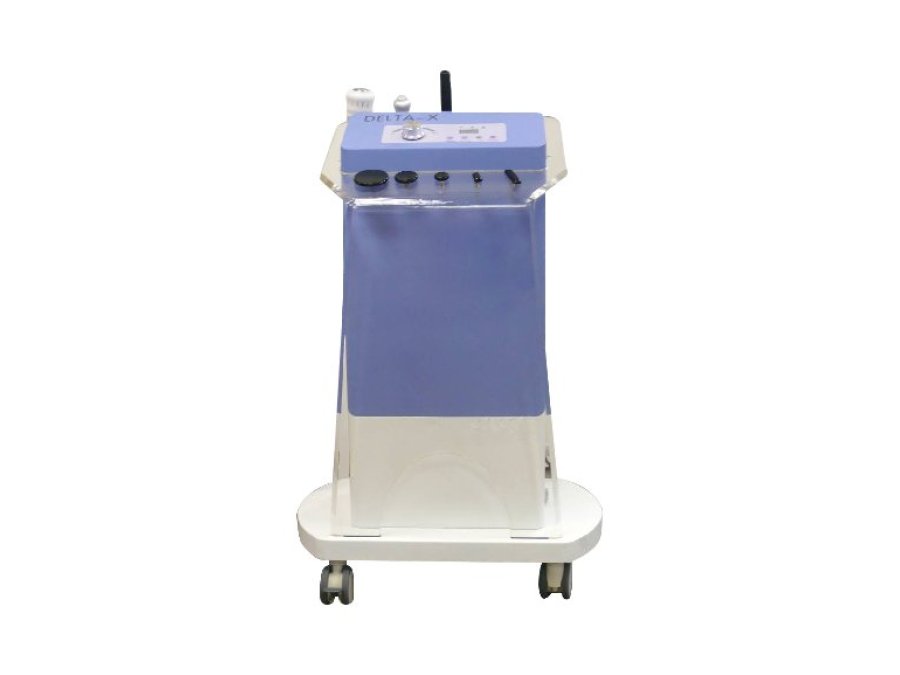
Postpartum abdominal skin laxity, diastasis-adjacent dermal redundancy, and Grade II–III edematous-fibrotic cellulite demand body-contouring systems capable of tightening large anatomical zones rapidly without surgical scarring. Comparing a Peltier-cooled cryo RF body contouring machine against 360° phase-controlled multipolar RF reveals how alternating thermal shock and multi-vector current steering govern adipocyte apoptosis, lymphatic drainage, and reticular collagen contraction.
Clinical Engineering Callout: Dual-Gradient Thermal Shock vs. Multi-Vector Phase Steering
Cryo-RF combines simultaneous -5°C to -10°C epidermal contact cooling with high-power deep RF heating (+43°C to +46°C subdermal), driving a 50°C+ thermal gradient that induces vascular contraction-dilation pumping and cold-induced adipocyte stress while keeping the skin surface pain-free. Conversely, 360° phase-controlled multipolar RF rotates polarity continuously across concentric electrode rings, eliminating cold spots and achieving uniform volumetric tightening over broad postpartum abdominal zones.
1. Cryo-RF Thermal Shock Physics: Cold Surface Protection & Deep Hyperthermia
Traditional body radiofrequency is often limited by patient epidermal heat tolerance: once surface skin exceeds 43°C–44°C, nociceptors trigger sharp discomfort, forcing operators to reduce power before deep subcutaneous tissue (1.5 cm–3.0 cm) reaches therapeutic lipolytic temperatures. A specialized cryo RF body contouring machine resolves this bottleneck using high-capacity TEC Peltier modules integrated directly into the RF applicator plate.
Chilling the metal-ceramic contact face to -5°C to -10°C anesthetizes superficial C-fiber thermal pain receptors while simultaneously lowering surface blood flow. Because higher-power 1 MHz–4 MHz RF current can then pass safely through the chilled epidermis without causing burns, deep subcutaneous fat and fibrotic septa heat rapidly to 44°C–47°C.
Additionally, alternating cold-to-hot or simultaneous cryo-thermal delivery produces rapid vasoconstriction followed by reactive vasodilation (‘vascular gymnastics’). This cyclic microcirculatory pump flushes stagnant interstitial fluid and metabolic waste out of cellulite lobules while triggering apoptosis in thermally stressed adipocytes.
- 50°C+ Vertical Thermal Gradient: Protects the epidermis while pushing deep subdermal fat past its metabolic lipolysis threshold.
- Immediate Dermal Tone via Cold Shock: Rapid cooling induces acute myofibrillar and elastic-fiber tautness visible immediately post-session.
- High Patient Comfort: Continuous cryo-analgesia allows higher RF wattage on sensitive inner thighs, flanks, and upper arms.
2. 360° Phase-Controlled Multipolar RF: Volumetric Uniformity & Postpartum Abdomen
Standard fixed-polarity bipolar RF concentrates electrical current strictly along the shortest path between two adjacent electrodes, creating shallow penetration (roughly half the inter-electrode gap) and uneven ‘hot spots’ directly beneath electrode rims. Modern 360° phase-controlled multipolar RF platforms replace static pairs with 4 to 8 concentric or radial electrodes governed by a real-time digital phase-shifting controller.
By continuously rotating active anode-cathode pairs in a 360° circular vector sequence, electrical arcs cross at multiple depths simultaneously—creating overlapping deep thermal planes from 5 mm down to 25 mm without requiring a distant return pad. When treating lax postpartum abdominal skin—which frequently combines thinned dermis, striae, and residual lower-abdominal fat—360° phase-controlled RF heats large 15×20 cm quadrants uniformly to 41°C–43°C within 3 minutes and sustains that plateau safely for 15–20 minutes.
3. Cellulite Pathophysiology & Combination Sequencing
Gynoid cellulite arises from three structural defects: hypertrophied subcutaneous fat lobules herniating upward, rigid vertical fibrous collagen septa pulling skin downward (creating dimples), and impaired local venolymphatic microcirculation. Cryo-RF targets the microvascular congestion and fat lobule volume via deep cryo-assisted lipolysis, whereas 360° multipolar RF (especially when paired with mechanical vacuum or LED photobiomodulation) thickens the overlying dermal canopy so underlying lobules become optically invisible.
For stubborn Grade III cellulite or postpartum laxity, clinicians frequently alternate modalities or sequence 360° multipolar RF on lax abdominal skin with Cryo-RF on dense trochanteric saddlebags and inner thighs.
4. Infrared Thermometry, Endpoint Monitoring & Session Economics
Maintain strict objective temperature monitoring using built-in handpiece IR sensors or an external non-contact medical thermometer. For 360° multipolar RF, hold surface temperature steadily at 41.5°C–43.0°C for at least 12–15 minutes per quadrant; for Cryo-RF, rely on sub-surface impedance tracking and patient deep-warmth feedback since the chilled plate masks surface temperature.
Schedule 6 to 8 sessions spaced 7 days apart, advising patients to drink 1.5–2 L of water daily and engage in 30 minutes of light cardiovascular movement within 12 hours post-treatment to oxidize mobilized free fatty acids.
Body Contouring Comparison: Cryo-RF Thermal Shock vs. 360° Phase-Controlled Multipolar RF
Clinical selection criteria comparing thermal mechanism, penetration depth, comfort profile, and optimal body contouring indications:
| Engineering & Clinical Metric | Cryo-RF Thermal Shock (CRYO LEO) | 360° Phase-Controlled Multipolar RF (360RF) |
|---|---|---|
| Surface Cooling Mechanism | Active TEC Peltier (-5°C to -10°C) | Passive thermal equilibrium (41°C – 43°C surface) |
| Deep Subdermal Target Temp | 44°C – 47°C deep adipose heating | 42°C – 44°C uniform reticular & septal heating |
| Electrode Field Topology | Focused cryo-plate monopolar/bipolar coupling | 360° rotating multi-electrode phase steering |
| Primary Physiological Effect | Adipocyte stress, vascular flush, firming | Broad dermal collagen contraction & cellulite smoothing |
| Optimal Clinical Indications | Localized stubborn fat, flanks, inner arms, edematous cellulite | Postpartum abdominal skin laxity, large-zone tightening, circumferential contouring |
| Recommended Course | 6–8 sessions (weekly) | 6–10 sessions (weekly or bi-weekly) |
5. Thermal-Shock Adipocyte Apoptosis & Vascular Gymnastics Physiology
Adipocytes exhibit notably higher susceptibility to thermal stress—both hyperthermia (>44°C) and localized cold shock—than adjacent fibroblasts, vascular endothelium, and dermal keratinocytes. When a cryo RF body contouring machine chills the upper 3 mm skin canopy to -5°C to -10°C while simultaneous RF current elevates deep subcutaneous fat (8–22 mm depth) to 44°C–47°C, lipid droplets inside mature adipocytes undergo structural destabilization and inflammatory macrophage recruitment (apoptosis) over the ensuing 4 to 8 weeks.
Simultaneously, alternating cold-to-warm vascular vasoconstriction and reactive hyperemia breaks the vicious cycle of edematous cellulite: lymphatic vessels dilate to clear stagnant mucopolysaccharides and interstitial fluid, while warmed fibrotic collagen septa soften under gentle manual mechanical pressure. Over 6 weekly sessions, skin surface dimpling visibly flattens while deep fat thickness decreases measurably by 1.5–3.5 cm in compliant patients.
6. Anatomical Zone Selection, Contraindications & Combination Body Protocols
- Postpartum Diastasis & Abdominal Laxity: Prioritize 360RF Phase-Controlled Multipolar RF across the supra- and infra-umbilical skin apron where dermal thinning and stretch marks predominate over deep fat volume; add CRYO LEO Cryo-RF strictly over persistent lower-abdominal or flank fat pockets.
- Sensitive Inner Thighs & Upper Arms: Thin, lax brachial and medial thigh skin heats rapidly and can burn easily under fixed bipolar probes. Cryo-RF’s continuous Peltier analgesia protects thin skin while allowing sufficient deep RF energy for firming.
- Contraindications: Screen carefully for cold-induced pathologies (cryoglobulinemia, cold urticaria, Raynaud’s phenomenon, paroxysmal cold hemoglobinuria) prior to Cryo-RF, plus standard RF exclusions including cardiac pacemakers, metallic abdominal mesh, pregnancy, active hernia at the treatment site, and severe hepatic/renal lipid-clearance impairment.
7. Chiller Loop Reliability, Peltier Calibration & Practice Profitability
Sustained clinical performance in Cryo-RF platforms depends on closed-loop liquid cooling behind the handpiece TEC Peltier module. Medical-grade radiators with de-ionized coolant circulation prevent thermal throttling during back-to-back 45-minute body sessions, ensuring consistent -5°C to -10°C plate output across a full 8-hour clinic schedule with zero per-shot cartridge consumables.
Expanded Thermal Shock Timing & Multi-Zone Stacking Parameters
When executing dual-modality body contouring with a cryo RF body contouring machine, clinicians must respect tissue thermal equilibration intervals between cryogenic vasoconstriction and multipolar volumetric heating. Cooling the epidermis to -2°C to -5°C for 90 seconds triggers peripheral arteriovenous shunting; switching rapidly to 360° phase-controlled RF forces dermal water and fibrous collagen septa to absorb radiofrequency energy without superficial thermal pain. Across post-partum infraumbilical laxity, maintain continuous figure-eight handpiece velocity (2.5–3.5 cm/s) with infrared thermometer verification holding dermal surface temperatures between 40°C and 42.5°C for at least 12–15 minutes per quadrant. Patients with cold urticaria, Raynaud’s phenomenon, cryoglobulinemia, or metallic abdominal implants must be screened out during intake.
Calibration of Multi-Electrode Penetration Across Fibrous Cellulite Grades
In Stage II and Stage III edematous-fibrotic cellulite across the posterior thighs and gluteal fold, alternating 1 MHz deep bipolar polarity with 2 MHz multipolar rotation reshapes distorted subcutaneous fat lobules without surface burns. Apply generous glycerine-rich conductive oil to reduce mechanical drag and prevent impedance spikes over dry skin. Schedule six weekly sessions followed by quarterly maintenance visits, pairing each appointment with post-session compression garments or brisk walking to mobilize released free fatty acids and interstitial lymphatic fluid efficiently.
Clinical Integration, Product Architecture & Pillar Reference
Equip your body sculpting center with the CRYO LEO Cryo-RF Thermal Shock System for localized fat-cell stress and vascular cellulite drainage, paired with the 360RF Phase-Controlled Multipolar RF Workstation for rapid postpartum abdominal tightening. Review broader RF impedance principles in our core medical aesthetic RF device guide.
Frequently Asked Questions (Clinical & Engineering)
How does a cryo RF body contouring machine burn fat without burning the skin?
Active Peltier cooling chills the epidermis to -5°C to -10°C while high-frequency RF current penetrates cleanly into the subcutaneous fat layer, raising deep adipose temperature to 44°C–47°C safely.
Which technology is better for loose postpartum abdominal skin?
360° phase-controlled multipolar RF excels for broad postpartum abdominal laxity because rotating multi-vector fields heat wide skin areas uniformly to 41.5°C–43°C, thickening the dermis and contracting stretched collagen.
Is there any downtime after Cryo-RF or 360° multipolar RF?
Zero downtime. Patients experience mild transient warmth or pinkness for 30–60 minutes and can return to work or exercise immediately.