Melasma and erythematotelangiectatic rosacea have historically been considered relative contraindications to aggressive thermal RF microneedling because uncontrolled bulk heat triggers rebound melanogenesis and vascular flushing. Modern sub-pulse fractional gold RF microneedling—operating via segmented Pulse-Wave (PW) bursts alongside Continuous-Wave (CW) options—solves this challenge by selectively coagulating hyperactive dermal capillaries and reinforcing a fragmented basement membrane zone (BMZ) without overheating melanocytes.
Clinical Engineering Callout: Pulsed-Wave (PW) Selective Electro-Coagulation vs. Continuous-Wave (CW)
In Continuous-Wave (CW) mode, a single long 200–500 ms RF burst radiates broad thermal halos suitable for deep scar remodeling and bulk dermal tightening. In Sub-Pulse / Pulsed-Wave (PW) mode, the generator fires rapid micro-bursts (e.g., 10–40 ms ON / 10–20 ms OFF) at 0.3–1.2 mm depth. Because micro-bursts respect the thermal relaxation time of surrounding collagen while concentrating current along leaky subpapillary vessels and basement membrane fibroblasts, PW mode stabilizes melasma and calms rosacea with zero PIH rebound.
1. Pathophysiology of Melasma Basement Membrane Disruption & Vascular Drive
Clinical histopathology demonstrates that refractory melasma is rarely just an epidermal melanin problem. Biopsies consistently reveal three deeper structural defects: (1) a fragmented, weakened dermal-epidermal basement membrane (Type IV collagen defects) allowing melanocytes and melanin granules to drop into the dermis (“pendulous melanocytes”), (2) senescent papillary fibroblasts secreting melanogenic stem cell factor (SCF), and (3) hyper-vascular endothelial networks releasing VEGF that fuels persistent pigment production.
Traditional ablative lasers or aggressive chemical peels strip the surface yet worsen vascular inflammation and basement membrane fragility—explaining high 6-month relapse rates. By contrast, sub-pulse fractional gold RF microneedling bypasses the epidermis mechanically with ultra-fine 300-micron insulated or non-insulated gold needles and delivers micro-pulsed 2 MHz radiofrequency directly at the 0.3 mm–0.8 mm dermal-epidermal junction.
- Basement Membrane Reconstruction: Controlled micro-pulsed RF stimulates Type IV collagen and laminin synthesis along the dermo-epidermal junction, sealing the barrier against further dermal pigment drop.
- Senescent Fibroblast Reset: Selective sub-ablative warming clears photoaged fibroblasts and normalizes melanocyte-stimulating paracrine signaling.
- Micro-Vascular Sealing: Short PW bursts selectively coagulate dilated subpapillary capillary loops driving both rosacea telangiectasias and vascular melasma.
2. Continuous-Wave (CW) vs. Sub-Pulse (PW) Parameter Architecture
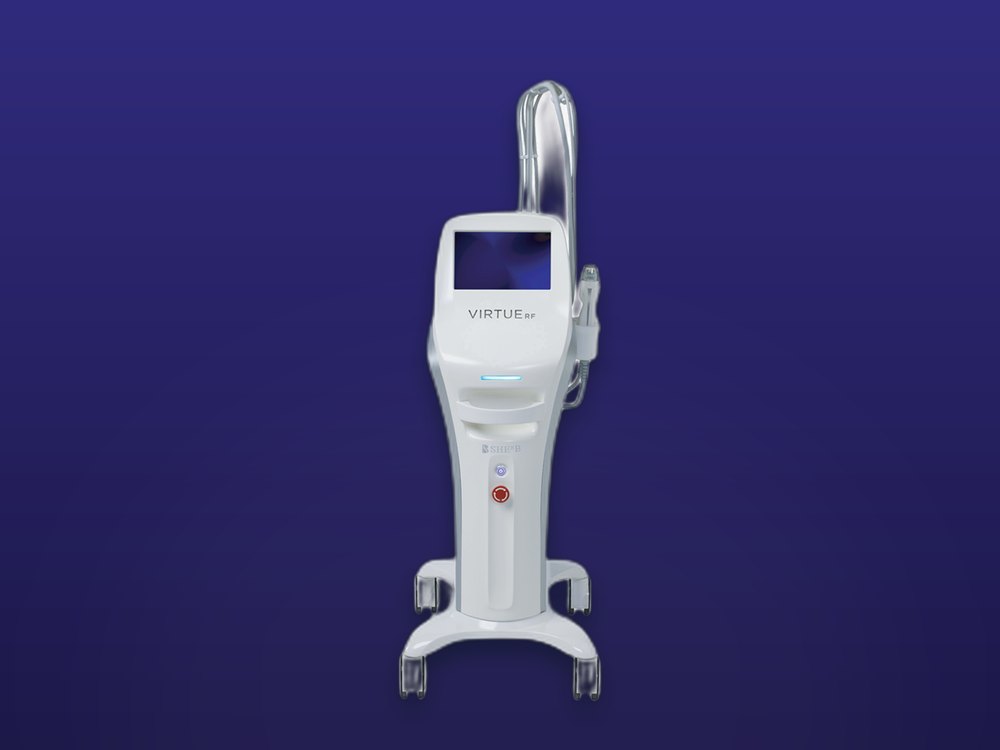
Modern dual-wave workstations—such as the VIRTUE RF Sub-Pulse Microneedling Platform and Gold RF Microneedling System—allow clinicians to switch between CW and PW waveforms within the same patient appointment depending on anatomical depth and pathology:
| Clinical Parameter | Sub-Pulse / Pulsed-Wave (PW) Mode | Continuous-Wave (CW) Mode |
|---|---|---|
| Waveform Geometry | Segmented micro-pulses (3–5 sub-bursts with cooling gaps) | Uninterrupted sustained RF emission |
| Optimal Insertion Depth | 0.3 mm – 1.2 mm (Papillary dermis & BMZ) | 1.5 mm – 3.5 mm (Reticular dermis & scar base) |
| Primary Indications | Melasma, vascular rosacea, PIE, fine periorbital pores | Atrophic acne scars, jawline laxity, striae distensae |
| Thermal Spread Profile | Tight pinpoint electro-coagulation around needle tips | Broad volumetric spherical collagen contraction |
| Topical Recovery Time | 4 – 12 hours mild pinkness (minimal pinpoint bleeding) | 24 – 48 hours erythema & mild micro-swelling |
| PIH Risk in Fitzpatrick IV–V | Ultra-low (melanin-blind + minimal bulk heat) | Low with insulated needles and reduced energy |
3. Step-by-Step Melasma & Rosacea Sub-Pulse Protocol
For mixed dermal-epidermal melasma or persistent rosacea erythema, restraint and depth accuracy outperform brute-force fluence:
- Preparation & Gentle Cleansing: Apply mild 4% lidocaine topical numbing cream for strictly 20–25 minutes (avoid excessive occlusive heating that vasodilates facial capillaries prior to treatment), then cleanse thoroughly with sterile saline.
- PW Depth & Energy Calibration: Set needle penetration strictly to 0.4 mm–0.8 mm over malar cheeks and 0.3 mm–0.5 mm over thin forehead or periorbital zones. Select PW sub-pulse mode at low-to-moderate power (Levels 2–4, pulse duration 100–150 ms total train) with single non-overlapping stamping passes.
- Immediate Post-Needling Infusion: Within 5 minutes of completing the PW pass—while micro-channels remain maximally patent—apply preservative-free sterile tranexamic acid (2%–5%), glutathione, or exosome recovery serum to suppress tyrosinase and calm vascular endothelial growth factor.
- Treatment Cadence: Perform 3 to 4 gentle PW sessions spaced 4 weeks apart, paired seamlessly with low-fluence 1064 nm laser toning or daily azelaic acid maintenance.
4. Integrated Cryo-Cooling Plates & Precision Stepper-Motor Control
Delivering reliable 0.3 mm–0.5 mm basement membrane therapy is impossible with sluggish spring-loaded handpieces that indent soft skin unevenly before needles actually pierce the stratum corneum. High-precision sub-pulse fractional gold RF microneedling handpieces combine silent linear stepper motors—inserting 25 or 36 ultra-sharp 24K gold-plated needles cleanly at exact programmed depth—with integrated Peltier Integrated Cooling Plates (ICP) that chill the surrounding epidermis to 5°C–10°C during firing.
This synergy cuts surface pain dramatically even over sensitive nasal bridges and upper lips, stabilizes capillary tone during rosacea treatment, and virtually eliminates post-procedure pinpoint oozing.
5. Multimodal Practice Synergy: Dual-Wave Facial Tightening + Pigment Control
Clinics treat complex aging faces with a dual-pass protocol in one sitting: first execute a deep 1.5 mm–2.5 mm Continuous-Wave (CW) pass along the lower jawline, marionette lines, and atrophic cheek scars to contract deep reticular collagen; then switch immediately to a 0.5 mm–0.8 mm Pulsed-Wave (PW) pass across malar melasma patches, enlarged T-zone pores, and diffuse redness—remodeling both structural lift and surface clarity simultaneously.
6. Contraindications, Anticoagulant Screening & Barrier Home Care
Screen out patients with active bacterial folliculitis, cystic nodulocystic acne flares directly in the stamping field (use targeted single-pin therapy instead), implanted cardiac pacemakers, gold-salt hypersensitivity, or isotretinoin use within 3 months. Post-care is strictly non-irritating: cool sterile hydrogel mask for 15 minutes in-clinic, bland ceramide moisturizer for 72 hours, zero harsh retinoids/AHAs for 5 days, and tinted zinc-oxide SPF 50+ daily.
7. Multi-Depth Impedance Compensation & Needle-Tip Sterility Engineering
Treating delicate melasma and rosacea dermis safely with sub-pulse fractional gold RF microneedling requires uniform current distribution across all 25 or 36 insulated gold pins—even when gliding from thick hydrated cheek dermis onto thin bony forehead or upper-lip skin. Advanced dual-wave RF consoles continuously monitor tissue electrical impedance at 1,000+ samples per second; whenever drier superficial epidermis elevates resistance, the generator modulates pulse output dynamically to avoid surface sparking while preserving crisp 0.4–0.8 mm basement membrane electro-coagulation.
Always utilize strictly single-patient EO-sterilized gold-plated cartridges and inspect the needle array under magnification before attaching it to the handpiece. Even minor mechanical bending from dropping a tip onto a stainless tray compromises Parylene insulation integrity and risks pinpoint epidermal burns. After completing each 15-minute PW melasma pass, document needle depth, pulse count, and serum pairing in the patient’s chart so subsequent monthly sessions refine pigment clarity progressively.
8. Integrated Sun-Shielding & Oral/Topical Maintenance Protocol
Even the cleanest sub-pulse RF microneedling protocol can lose clinical gains if a melasma patient resumes unprotected midday sun exposure or hot yoga within 48 hours of treatment. Provide a written 7-day post-care card mandating broad-spectrum tinted zinc-oxide/iron-oxide SPF 50+ sunscreen (blocking visible blue light as well as UV-A/UV-B), gentle non-foaming cleansers, and strict avoidance of steam saunas for 72 hours. Reintroduce gentle topical tyrosinase inhibitors (such as 15% azelaic acid, cysteamine, or 4% niacinamide) on Day 5 once barrier hydration normalizes.
Expanded Dermal Melanin Clearance & Quarterly Protocol Cadence
Sustaining remission in recalcitrant vascular-dermal melasma requires combining initial monthly sub-pulse Pulsed-Wave RF microneedling passes with gentle quarterly barrier reinforcement. After completing the primary 4-session series, evaluate pigment homogeneity under Wood’s lamp or cross-polarized photography: epidermal pigment haze responds well to low-fluence 1064 nm Q-Switched laser toning every 4 weeks, while persistent malar telangiectatic blushing benefits from a single low-energy 0.5 mm PW RF maintenance pass every 12 weeks paired with topical cysteamine or azelaic acid.
Clinical Photography & Wood’s Lamp Tracking
Objective evaluation of melasma and vascular rosacea progress relies on standardized cross-polarized and UV-fluorescence imaging at Baseline, Week 8, and Week 16. Because sub-pulse PW RF microneedling stabilizes deeper dermal basement membrane architecture before epidermal surface melanin clears completely, comparing serial UV fluorescence views demonstrates dramatic reductions in sub-clinical vascular hyperemia and deep dermal pigment haze even before final topical brightening serums complete surface turnover.
Clinical Integration, Product Architecture & Pillar Reference
Introduce dual-wave CW/PW precision to your dermatology practice with the VIRTUE RF Sub-Pulse Microneedling Platform and Gold Insulated RF Microneedling Workstation. Explore full anatomical depth mapping (0.5–3.5 mm) and tissue impedance feedback inside our core medical aesthetic microneedling device clinical guide.
Frequently Asked Questions (Clinical & Engineering)
Why is sub-pulse fractional gold RF microneedling safe for melasma?
Short Pulsed-Wave (PW) micro-bursts reinforce the dermo-epidermal basement membrane and coagulate hyperactive subpapillary blood vessels at 0.3–0.8 mm depth without generating bulk epidermal heat that triggers rebound pigmentation.
How does PW mode differ from CW mode on RF microneedling systems?
CW (Continuous-Wave) fires a sustained thermal pulse ideal for deep scar remodeling and collagen tightening, whereas PW (Pulsed-Wave) segments energy into rapid micro-bursts with cooling gaps for delicate melasma, rosacea, and pore refinement.
What topical serums pair best immediately after PW melasma microneedling?
Sterile, preservative-free tranexamic acid, niacinamide, PDRN, and biomimetic exosomes maximize pigment suppression and barrier repair through open micro-channels.