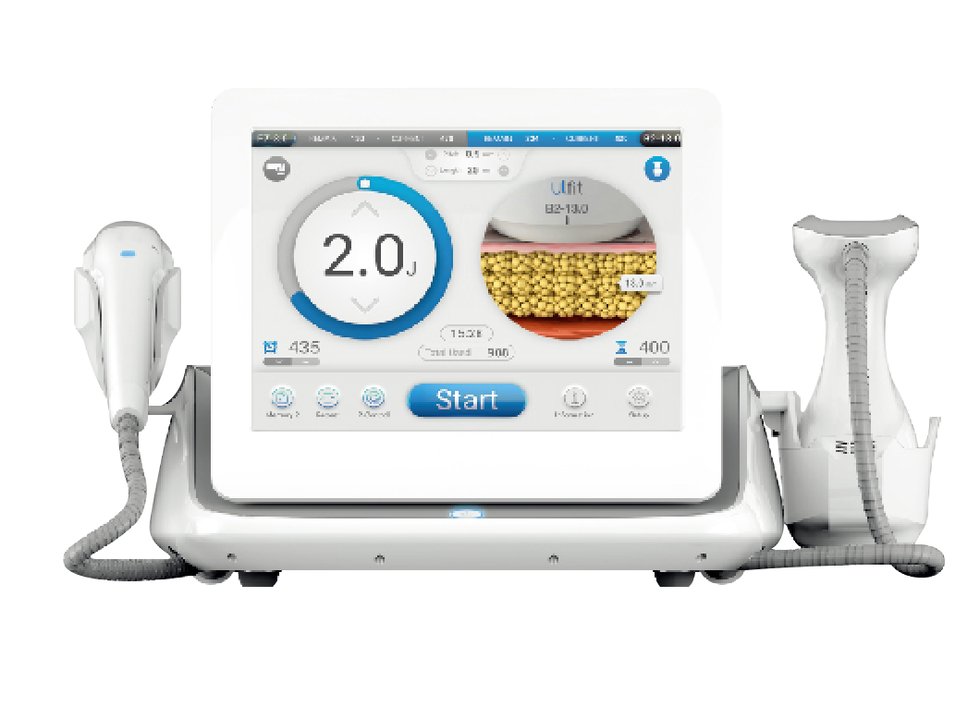
Non-surgical body contouring demands enough thermal energy to induce permanent adipocyte apoptosis at 6 mm to 13 mm depth without injuring overlying skin or deeper muscle fascia. Conventional linear HIFU cartridges fire slowly along narrow 25 mm tracks, leaving gaps and extending session times past 90 minutes. 2MHz macro-focused ultrasound lipolysis—engineered via Macro-Focused Circular Ultrasound (MFCU Lipo Knife) handpieces—delivers 8x larger macro-focal thermal zones in rapid continuous rotary sweeps for fast, uniform flank, abdominal, and submental fat reduction.
Clinical Engineering Callout: Why 2 MHz Macro-Focused Ultrasound Excels in Adipose Cavitation
Acoustic attenuation increases linearly with frequency. While 7 MHz micro-focused beams attenuate rapidly in the upper dermis, a low-frequency 2 MHz macro-focused transducer penetrates effortlessly through thick fibrous subcutaneous septa down to 6.0 mm, 9.0 mm, and 13.0 mm. Each macro-focal point generates a broad 2–3 mm thermal-mechanical cavitation zone (65°C–72°C) that ruptures adipocyte membranes permanently while simultaneously shrinking surrounding reticular fibrous septa to prevent post-fat-loss skin sagging.
1. Macro-Focused Circular Ultrasound (MFCU) vs. Micro-Focused Linear HIFU
Understanding the distinction between micro-focused (MFU) facial cartridges and macro-focused (MFCU) body transducers is critical for profitable clinic body-sculpting outcomes. Micro-focused transducers create tiny ~0.5 mm³ coagulation dots suited for tightening thin facial fascia; firing tiny dots across a large abdomen wastes thousands of cartridge lines and fails to achieve uniform bulk adipose heating.
In contrast, 2MHz macro-focused ultrasound lipolysis on the MFCU Lipo Knife Body Contouring System uses wide-aperture circular piezoelectric bowls that converge high-intensity 2 MHz waves into dense macro-thermal zones. Moving the circular ergonomic probe in smooth continuous arcs (“painting” or rotary stamping) saturates targeted fat pads evenly with zero untreated checkerboard streaks.
- 8x Larger Focal Volume: Macro-focal geometry heats significantly greater cubic millimeters of subcutaneous adipose tissue per second than facial 4 MHz/7 MHz transducers.
- Dual Lipolysis + Septal Tightening: Mechanical acoustic cavitation disrupts fat cell membranes while 65°C thermal dispersion contracts vertical fibrous septa, tightening overlying skin simultaneously.
- Zero Suction Trauma: Unlike cryolipolysis applicators—which require painful vacuum pinching and risk paradoxical adipose hyperplasia (PAH)—MFCU treats both pinchable and fibrous non-pinchable fat pads smoothly.
2. Depth Mapping Protocol: 6.0 mm, 9.0 mm & 13.0 mm Subcutaneous Layers
Accurate adipose pinch thickness measurement using mechanical calipers or diagnostic ultrasound is mandatory prior to selecting cartridge depths during 2MHz macro-focused ultrasound lipolysis:
- 6.0 mm Body/Submental Transducer (2 MHz): Designed for areas with 1.0–1.5 cm pinch thickness, including stubborn double-chin submental fullness, bra-line rolls, inner knees, and upper-arm triceps laxity.
- 9.0 mm Transitional Adipose Transducer (2 MHz): Ideal for patients with 1.5–2.2 cm pinch thickness across upper abdomen, love handles (flanks), outer saddlebags, and posterior banana rolls beneath the gluteal fold.
- 13.0 mm Deep Abdominal Transducer (2 MHz): Reserved exclusively for thick subcutaneous fat pads exceeding 2.5 cm pinch thickness (e.g., infraumbilical belly pouch and heavy flanks), delivering energy strictly inside the deep fat layer well above the rectus sheath.
3. Biological Clearance Cascade: Macrophage Phagocytosis & Lipid Transport
Once 2 MHz macro-focal thermal-mechanical energy raises local adipocyte temperatures past 58°C–65°C for a brief millisecond burst, cell membranes lose structural integrity and undergo irreversible coagulative necrosis and delayed apoptosis. Over the ensuing 4 to 12 weeks, chemotactic signals recruit macrophages to engulf extruded triglycerides and cellular debris.
Cleared lipid droplets are transported gradually via the lymphatic system to the liver for normal beta-oxidation—without elevating serum cholesterol or triglyceride blood panels beyond physiological baselines. Clinicians encourage patients to drink 2.0–2.5 liters of water daily and perform 30 minutes of brisk cardiovascular activity within 48 hours post-session to accelerate lymphatic clearance.
4. Safe Grid Marking, Movement Velocity & Bony Prominence Margins
Because 2 MHz ultrasound carries substantial deep acoustic power, clinicians must divide the abdomen or thighs into 10 cm × 10 cm treatment squares before applying liberal ultrasound coupling gel. Never fire 9.0 mm or 13.0 mm cartridges directly over the iliac crest, costal rib margins, umbilicus scar hernia rings, or thin medial ankle tendons.
Maintain steady circular motion (2–3 cm/s) and verify flush acoustic contact at all times; if the patient reports sharp surface stinging, wipe and reapply fresh chilled gel immediately to eliminate micro-air bubbles that trap acoustic energy at the epidermis.
Clinical Comparison: 2MHz MFCU Lipo Knife vs. Cryolipolysis & Laser Lipolysis
Compare depth targeting, consumable economics, skin-tightening synergy, and complication profiles across leading non-invasive fat reduction technologies:
| Clinical Parameter | 2 MHz MFCU Lipo Knife (6 / 9 / 13 mm) | Cryolipolysis Vacuum Applicator | 1060 nm Diode Laser Lipolysis |
|---|---|---|---|
| Mechanism of Action | Macro-focused acoustic thermal-mechanical cavitation | Sub-zero vacuum fat freezing apoptosis | Bulk hyperthermic laser heating (42°C–47°C) |
| Depth Selectivity | Exact 6.0 / 9.0 / 13.0 mm calibrated planes | Fixed suction cup pull depth (~15–20 mm) | Diffuse 5–15 mm thermal gradient |
| Non-Pinchable Fat Capability | Yes (glides smoothly over firm fibrous fat) | No (requires sufficient tissue to pull into cup) | Yes (flat contact panels) |
| Simultaneous Skin Tightening | Strong (65°C fibro-septal contraction) | Minimal (risk of laxity after fat loss) | Moderate dermal collagen heating |
| PAH Risk (Paradoxical Hyperplasia) | Zero documented PAH risk | 0.05% – 0.4% documented PAH risk | Zero |
| Consumable Cost per Session | Low (high-shot circular transducers + gel) | High (single-use gel pads & cycle cards) | Moderate (cooling coupling trays) |
5. Multimodal Body Synergy: Pairing MFCU Lipo Knife With 448kHz TECAR or Cryo-RF
Leading medical spas optimize circumference reduction by combining 2MHz macro-focused ultrasound lipolysis on Day 1 with 448 kHz CET/RET TECAR or 360° multipolar radiofrequency 7–10 days later. While MFCU permanently destroys deep adipocytes across the 9 mm and 13 mm layers, subsequent RF and TECAR lymphatic drainage accelerate macrophage clearance of emulsified lipids and polish superficial cellulite dimpling.
6. Contraindications, Liver Function Screening & Package Architecture
- Absolute Contraindications: Abdominal wall or umbilical hernias, pregnancy or within 3 months post-cesarean delivery, severe hepatic or renal impairment, implanted abdominal stimulators or insulin pumps, active dermatitis, and anticoagulation therapy predisposing to deep bruising.
- Pinch Test Minimums: Never apply a 13.0 mm cartridge unless compressed pinch thickness exceeds 2.5 cm, and never apply a 9.0 mm cartridge below 1.5 cm pinch thickness.
- Recommended Course: Deliver 2 to 3 sessions spaced 4 weeks apart per anatomical zone, capturing standardized circumferential measurements and 3D lighting photos at Baseline, Week 4, and Week 12.
7. Ergonomic Grid Execution, Overlap Control & Post-Treatment Thermal Comfort
Achieving smooth, lump-free contour reduction with 2MHz macro-focused ultrasound lipolysis hinges on systematic spatial overlap and steady acoustic thermal pacing. Divide each target abdomen, flank, or posterior thigh into numbered 10 cm × 10 cm squares using a surgical skin pencil, budgeting 300–500 continuous macro-focused pulses per grid square depending on patient tolerance and pinch thickness. Rather than dwelling statically over a single spot—which can overheat subcutaneous fibrous septa and cause temporary tender nodules—sweep the circular handpiece in slow, overlapping figure-eight paths at 2–3 cm per second.
If a patient experiences sharp deep prickling over a superficial fibrous band, reduce energy output by 0.1–0.2 J and widen the sweeping radius slightly rather than lifting the probe mid-pulse. Immediately after completing the 9 mm or 13 mm deep pass, switch to a 6.0 mm or 4.5 mm pass along the outer perimeter of the treatment zone to feather the transition smoothly into untreated surrounding fat, preventing visible step-off borders between contoured and adjacent tissue.
8. Patient Metabolic Optimization & Clinic Package Structuring
Because MFCU Lipo Knife triggers genuine adipocyte membrane lysis rather than temporary water dehydration, patient lifestyle habits during the 4–12 week macrophage clearance window directly shape final waist-to-hip outcomes. Educate patients to prioritize lean protein intake, restrict refined simple sugars for 14 days post-session to keep insulin-driven lipogenesis suppressed, and wear light breathable compression panels over the abdomen during the first week to support lymphatic fluid mobilization. Structuring 3-session body contouring packages bundled with baseline and Week-12 3D circumference scanning maximizes patient compliance and drives high-margin cross-sells into postpartum skin tightening and cellulite smoothing programs.
Expanded Circumferential Measurement SOP & Post-Sculpt Lymphatic Care
Objective measurement discipline turns subjective fat-reduction inquiries into high-converting word-of-mouth referrals. Record standardized standing circumference measurements at fixed anatomical landmarks—measuring exact distance above or below the umbilicus, iliac crest, and mid-thigh—under consistent morning hydration prior to Session 1 and again at Week 8 and Week 12. Encourage light 20-minute daily walking and 2.5 L water intake during the first 10 days after 2 MHz MFCU Lipo Knife cavitation so lymphatic capillaries clear emulsified adipocyte triglycerides cleanly without transient lower-abdominal bloating.
Clinical Integration, Product Architecture & Pillar Reference
Equip your body-sculpting department with the MFCU Lipo Knife 2MHz Macro-Focused Ultrasound System, engineered with calibrated 6 mm, 9 mm, and 13 mm circular cartridges for rapid non-invasive lipolysis and skin tightening. Review our core medical aesthetic HIFU device clinical monograph for complete micro- vs. macro-focused ultrasound physics.
Frequently Asked Questions (Clinical & Engineering)
How is 2MHz macro-focused ultrasound different from facial HIFU?
Facial HIFU uses 4–7 MHz micro-focused beams for tiny superficial coagulation points, whereas 2 MHz macro-focused ultrasound penetrates deeper (6–13 mm) with larger focal volumes optimized to disrupt adipocytes permanently.
Can MFCU Lipo Knife treat stubborn fat that cannot fit into a cryolipolysis cup?
Yes. Because MFCU uses a free-gliding circular probe rather than vacuum suction, it smoothly contours fibrous outer thighs, upper back bra rolls, and submental pads that suction cups cannot grasp.
When do patients see final circumference reduction after 2MHz ultrasound lipolysis?
While mild septal tightening appears within 2 weeks, full macrophage clearance of disrupted fat cells unfolds progressively between Weeks 4 and 12.