For decades, dermatologists treating severe atrophic acne scars or multi-colored professional tattoos faced a stark trade-off between aggressive ablative downtime and sluggish pigment clearance. The modern honeycomb MLA fractional picosecond laser transforms both indications through ultra-short 350–450 picosecond pulse durations: delivering pure photoacoustic shockwaves for tattoo ink pulverization and Laser-Induced Optical Breakdown (LIOB) plasma cavitation for zero-crusting dermal scar remodeling.
Clinical Engineering Callout: LIOB Vacuole Formation: Sub-Surface Plasma Without Epidermal Ablation
When a high-peak-power 1064 nm picosecond beam passes through a hexagonal Microlens Array (MLA), energy concentrates into hundreds of discrete focal spots exceeding 10¹¹ W/cm² irradiance inside the papillary dermis. At this threshold, melanin and hemoglobin seed multiphoton ionization, creating microscopic plasma-induced LIOB cavitation bubbles beneath an intact stratum corneum—stimulating intense neocollagenesis with only 24–48 hours of erythema.
1. Stress Confinement & Photoacoustic Shockwaves (350–450 ps vs. Nanoseconds)
In selective photothermolysis, pulse duration must be shorter than the target chromophore’s Thermal Relaxation Time (TRT) and Stress Relaxation Time (SRT). Because melanosomes and exogenous tattoo ink particles measure just 10–100 nanometers in diameter, their SRT falls well below 1 nanosecond. Conventional Q-switched Nd:YAG lasers (5–20 ns) exceed this acoustic window, relying heavily on photothermal heating that diffuses into adjacent tissue and elevates post-inflammatory hyperpigmentation (PIH) risk.
Ultra-short 350–450 picosecond pulses achieve true stress confinement. Optical energy deposits faster than acoustic pressure waves can escape the ink granule, generating a violent mechanical shockwave that shatters dense 1-micron tattoo aggregates into sub-50-nanometer dust particles easily cleared by dermal macrophages in half the number of clinical sessions.
- Multi-Wavelength Ink Targeting: 1064 nm clears black, dark blue, and deep dermal pigment; frequency-doubled 532 nm clears red, orange, and yellow inks; 585/650 nm or 755 nm dye/solid-state handpieces address recalcitrant sky-blue and emerald-green chromophores.
- Reduced Thermal Collateral Damage: Lower thermal diffusion permits higher clinical clearance rates on stubborn ghosted tattoos resistant to nanosecond Q-switched lasers.
2. Honeycomb MLA Fractional LIOB Cavitation for Atrophic Acne Scars
Snapping a precision diffractive or refractive honeycomb MLA fractional picosecond laser handpiece onto the articulated arm redistributes the collimated beam into 100–160 high-fluence micro-beams per pulse while leaving 80%+ of the beam footprint at low background energy. As each micro-beam focuses ~200–600 microns beneath the surface, peak irradiance crosses the optical breakdown threshold.
This triggers Laser-Induced Optical Breakdown (LIOB): an expanding micro-plasma plume creates sub-epidermal mechanical vacuoles (cavitation bubbles) within the papillary and upper reticular dermis. Crucially, the overlying stratum corneum remains completely intact—preventing oozing, infection, and prolonged exudative crusting common with 10,600 nm CO2 lasers. The body responds to these localized acoustic micro-tears by releasing cytokines, upregulating TGF-beta, and synthesizing dense new Type I and Type III collagen and elastin bundles across rolling and shallow boxcar acne scars.
3. Clinical Parameters: Melasma Toning, Acne Scars & Multi-Color Tattoo Removal
Calibrating spot size and fluence cleanly separates benign rejuvenation from aggressive tattoo shattering. For atrophic acne scars and enlarged pores using the 1064 nm MLA handpiece (7–8 mm fractional spot), select 0.8–1.6 J/cm² at 5–10 Hz across 2–3 cross-hatched passes until pinpoint petechial erythema appears without epidermal blistering.
For recalcitrant multi-color tattoos using the flat-top zoom handpiece, initiate 1064 nm (black/blue) at 3–5 mm spot size and 2.5–4.5 J/cm², or 532 nm (red/orange) at 3–4 mm and 0.8–1.8 J/cm², targeting immediate uniform white ‘frosting’ (micro-gas bubble formation) without pinpoint bleeding or skin rupture. Allow 6–8 weeks between tattoo sessions for lymphatic macrophage clearance.
4. Fitzpatrick IV–VI Safety & Post-Procedure Barrier Management
Because LIOB plasma initiation is seeded partially by epidermal/dermal melanin, darker Fitzpatrick IV–VI skin requires slightly more conservative MLA fluences (0.5–1.0 J/cm² at 1064 nm) to keep cavitation inside the dermis rather than fracturing the basal layer. Immediately post-procedure, apply sterile cooling hydro-gel masks for 15 minutes followed by ceramide barrier repair balm and strict SPF 50+ sunscreen.
Picosecond Clinical Protocol Matrix: Flat-Top Zoom vs. Honeycomb MLA Fractional
Configure wavelength, handpiece optics, spot size, fluence, and clinical endpoint by dermatologic indication:
| Indication | Wavelength & Optic | Spot Size | Fluence Range | Expected Endpoint | Interval |
|---|---|---|---|---|---|
| Atrophic Acne Scars / Pores | 1064 nm Honeycomb MLA | 7 – 8 mm fractional | 0.8 – 1.6 J/cm² | Diffuse erythema + mild pinpoint petechiae | 4 weeks |
| Melasma / PIH Toning | 1064 nm Flat-Top (or MLA low) | 8 – 10 mm | 0.4 – 0.8 J/cm² | Faint transient erythema (zero frosting) | 2–3 weeks |
| Black / Dark Blue Tattoo | 1064 nm Flat-Top Zoom | 3 – 5 mm | 2.0 – 4.5 J/cm² | Immediate crisp white frosting | 6–8 weeks |
| Red / Orange / Yellow Tattoo | 532 nm Flat-Top Zoom | 3 – 4 mm | 0.8 – 1.8 J/cm² | Immediate light frosting, no bleeding | 6–8 weeks |
| Photoaging / Enlarged Pores (Fitz IV–VI) | 1064 nm Honeycomb MLA | 8 mm fractional | 0.5 – 0.9 J/cm² | Mild warmth & pinkness | 4 weeks |
5. Beam Collimation, Articulated Arm Alignment & Optical Breakdown Thresholds
Generating reproducible LIOB plasma vacuoles inside the dermis requires extraordinarily high peak optical power (typically ≥0.8–1.5 GW) delivered through an articulated mirror arm with minimal mode distortion. Many budget ‘picosecond’ systems actually operate at 1–2 nanoseconds with insufficient peak energy to cross the 10¹¹ W/cm² optical breakdown threshold—resulting in ordinary photothermal heating rather than true photoacoustic LIOB cavitation.
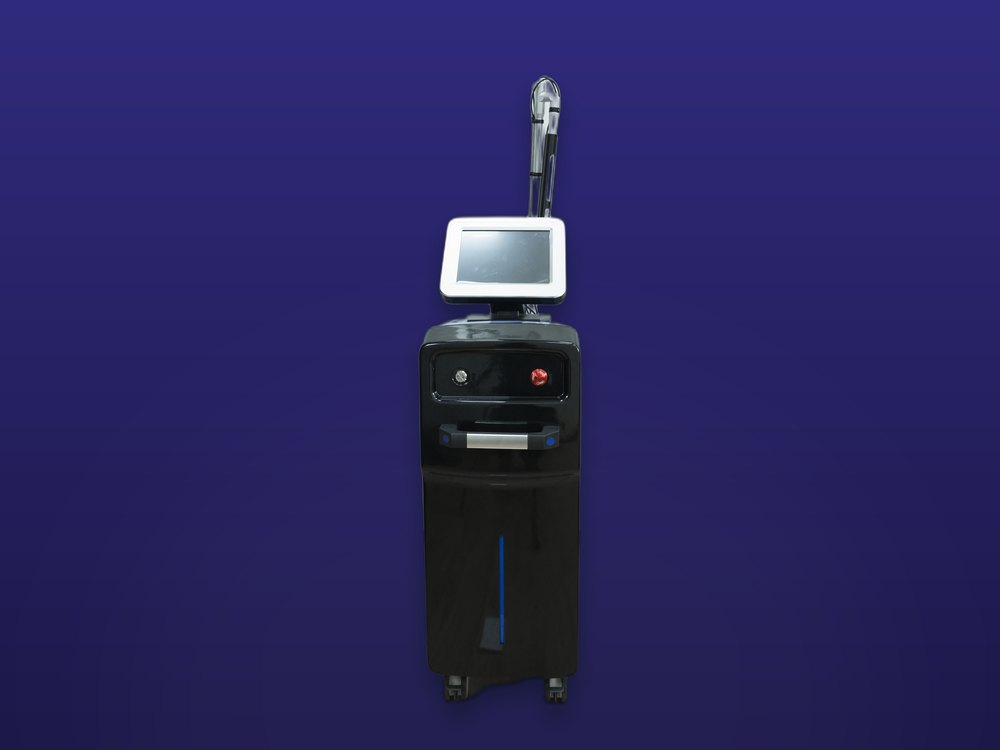
On the PICOSTAR Picosecond Laser platform, precision electro-optic Q-switching maintains pulse widths of 350–450 picoseconds across high-repetition 1–10 Hz scanning. When fitted with the hexagonal honeycomb MLA fractional picosecond laser lens array, each micro-beam preserves crisp focal convergence 250–600 microns beneath the stratum corneum. Clinicians verify true LIOB activation clinically by observing subtle sub-surface audible ‘snapping’ and immediate mild erythema without epidermal blistering or surface char.
6. Multi-Color Ink Wavelength Physics, Ghosting Prevention & Safety Exclusions
- Wavelength Matching by Ink Chromophore: Black carbon and dark India ink absorb strongly at 1064 nm; red cinnabar, iron oxide, and orange azo dyes require 532 nm; recalcitrant sky-blue phthalocyanine and emerald-green copper inks demand 650 nm or 755 nm wavelengths when 1064 nm plateaus.
- Preventing Paradoxical Tattoo Darkening: Cosmetic eyebrow, lip-liner, and flesh-toned camouflage inks frequently contain ferric oxide (Fe₂O₃) or titanium dioxide (TiO₂). High-energy picosecond or Q-switched impacts chemically reduce ferric oxide into black ferrous oxide (FeO), causing immediate ink blackening. Always perform a discrete 1-pulse test spot behind a cosmetic tattoo tail before treating the entire brow.
- Contraindications & Pre-Treatment Care: Defer treatment over suspicious pigmented nevi, active keloid borders, recent sunburn/tanning within 14 days, gold-salt therapy (chrysiasis risk), or active herpes simplex outbreaks. Prohibit aspirin or high-dose fish oil for 48 hours prior to intense MLA scar sessions to minimize sub-surface petechial bruising.
7. High-Margin Clinic Positioning: Tattoos + Zero-Crust Acne Scar Packages
Equipping a practice with both flat-top zoom tattoo optics and Honeycomb MLA fractional optics turns a single capital investment into a dual-revenue engine: capturing high-value multi-session tattoo clearance patients alongside cash-pay acne scar, pore-refinement, and melasma toning patients who return quarterly for maintenance.
Expanded LIOB Vacuole Healing Dynamics & Multi-Wavelength Tattoo Stacking
Histological biopsy studies confirm that plasma-induced LIOB cavitation vacuoles generated by a honeycomb MLA fractional picosecond laser resolve over 4 to 7 days without disrupting the overlying dermo-epidermal junction. Mast cell degranulation remains minimal compared to long-pulsed thermal lasers, allowing safe treatment of Asian and Latin American Fitzpatrick III–V patients with mixed rolling and boxcar acne scarring. When clearing recalcitrant multi-color tattoos containing iron-oxide browns, turquoise phthalocyanines, or dense carbon blacks, limit same-session pass counts to a single uniform pass per wavelength (1064 nm for black/blue, 532 nm for red/orange) spaced 8 weeks apart so lymphatic macrophages clear fragmented sub-micron pigment particles cleanly without hypertrophic scarring or transient hypopigmentation.
Articulated Arm Alignment, Fluence Calibration & Ocular Safety
True 350–450 picosecond peak power demands rigid 7-joint mirror-articulated delivery arms rather than fiber-optic cables that stretch pulse durations. Perform routine spot-profile burn-paper audits monthly to verify uniform honeycomb microlens energy distribution across the full 6 mm or 8 mm treatment beam. Require OD7+ wavelength-certified laser safety eyewear for every person inside the treatment suite, utilize wet white cotton gauze over eyebrows or permanent eyeliner tattoos, and apply bland petrolatum-free soothing hydrogel masks for 15 minutes immediately after intensive LIOB pinpoint petechiae sessions.
Clinical Integration, Product Architecture & Pillar Reference
Clinical dermatology practices can deliver ultra-short 350–450 ps acoustic precision using the PICOSTAR Picosecond Laser Platform with interchangeable Honeycomb MLA and flat-top zoom optics, alongside dual-band toning capabilities on the HELIOS III Pigment Laser System. Dive deeper into nanosecond vs. picosecond physics in our core medical aesthetic laser device comparison.
Frequently Asked Questions (Clinical & Engineering)
What is LIOB cavitation in a honeycomb MLA fractional picosecond laser?
Laser-Induced Optical Breakdown (LIOB) occurs when MLA-focused picosecond micro-beams reach ultra-high irradiance inside the dermis, creating microscopic plasma cavitation bubbles that stimulate collagen remodeling while keeping the epidermis intact.
Why does picosecond clear stubborn tattoos faster than Q-switched nanosecond lasers?
Picosecond pulses satisfy acoustic stress confinement for tiny ink particles, shattering ink into ultra-fine sub-50nm fragments via photoacoustic shockwaves rather than heat, accelerating macrophage clearance.
How much downtime follows honeycomb MLA acne scar treatment?
Most patients experience 24 to 48 hours of erythema and occasional pinpoint sub-surface petechiae, with zero open oozing or heavy crusting.