The Optical Melanin vs Penetration Paradox
Permanent follicular reduction requires adequate radiant energy absorption by follicular matrix melanin while preserving surrounding epidermal melanin. The fundamental clinical dilemma is governed by two competing optical parameters:
- Melanin Absorption Coefficient: Highest at shorter wavelengths (755 nm > 808 nm >> 1064 nm).
- Optical Penetration Depth: Scattering decreases as wavelength increases; longer wavelengths penetrate deeper into the dermis to reach deep terminal hair bulbs (3–5 mm depth).
Wavelength Comparison: 755nm vs 808nm vs 1064nm
| Parameter | 755nm Alexandrite | 808nm Diode Laser | 1064nm Long-Pulsed Nd:YAG |
|---|---|---|---|
| Melanin Selectivity | Highest | Optimal Balance | Lowest |
| Penetration Depth | 2.5 – 3.5 mm | 3.5 – 4.5 mm | 4.5 – 6.0 mm |
| Safe Fitzpatrick Types | Types I – III only | Types I – V (Universal) | Types IV – VI |
| Fine Hair Efficacy | Excellent | Very High | Poor (Requires high fluence) |
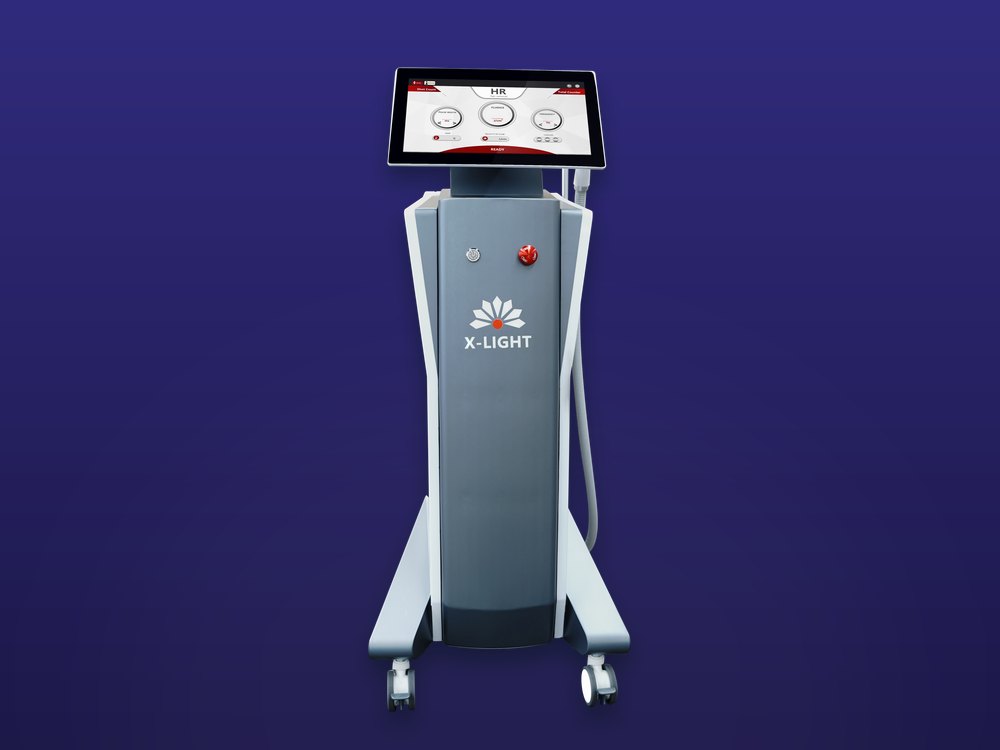
The 808nm diode wavelength provides the sweet spot for modern high-volume clinics: robust melanin absorption sufficient to destroy fine and medium hairs, combined with sufficient dermal penetration to reach deep terminal bulbs without blistering darker epidermal phototypes.